TVMounty installation guides
How to Choose a TV Mount Above a Fireplace: Centering and Clearance
Choose the mount only after the exact TV and fireplace instructions permit the location and the wall support can be identified. Then compare where each candidate can attach, how it centers the parked screen over the mantel and whether its movement clears the mantel and nearby objects. A mount that reaches the preferred viewing position while extended may return off-center when folded.

First decide whether the location is suitable
A fireplace can affect the TV's operating environment, ventilation, service access and the wall's construction. Some television manufacturers advise against mounting above a fireplace. A tilt mechanism, a pull-down arm or a single temperature reading cannot override a product's instructions.
Read the model-specific guidance for the TV, fireplace and proposed mount. If the requirements conflict, the wall assembly is unknown or the desired cable route crosses a restricted area, stop and resolve that before choosing hardware. Our fireplace feasibility guide separates heat, support and viewing-position decisions. A picture of the wall does not establish what supports the mount.
Measure the target and available support
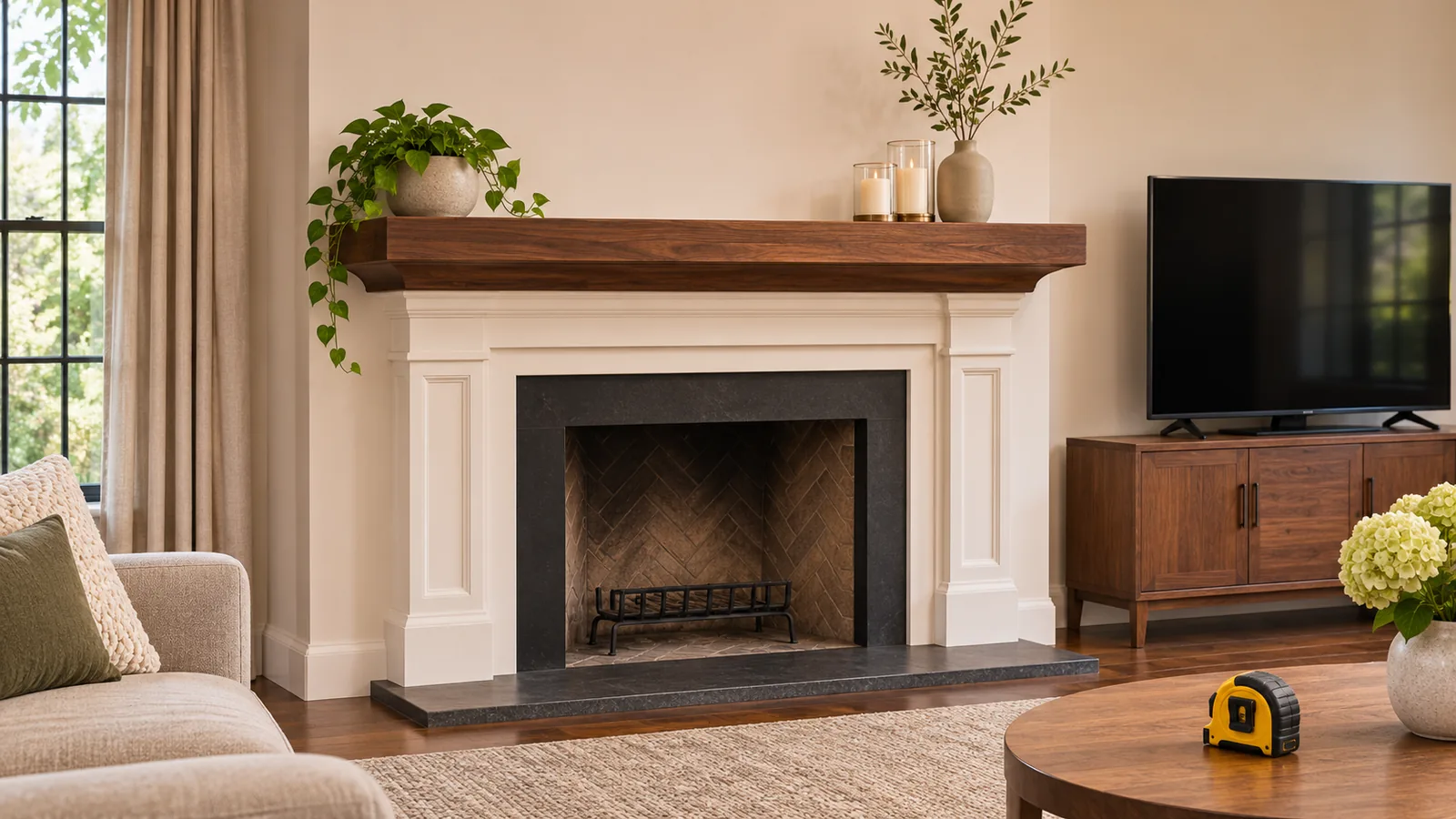
Mark the mantel center and the desired screen outline with removable tape. Record the screen's actual width and height, weight without its stand, mounting-hole pattern and the size and location of a soundbar that moves with it. Measure the available space to the ceiling or trim and the projection of the mantel from the wall.
Record verified fastening locations separately from the visual center. The midpoint of two wood studs can be offset from the fireplace; masonry or a layered finish needs its own assessment. Do not assume the stone or tile face is structural, and do not drill through an unknown layer to find out.
Planning example: the mantel center is 5 inches right of the midpoint of two verified studs. A candidate must explain how its permitted plate placement and documented screen or arm adjustment reach that target when parked. Five inches here is a hypothetical measured difference, not a promised adjustment range.

Compare three positioning approaches
A wide wall plate may provide more choice in locating permitted fasteners, but its outside width is not the same as usable slot span. It must still attach to the actual support exactly as the manual specifies. A broad plate alone does not guarantee the screen will center.
A TV-bracket lateral shift moves the TV interface relative to a fixed wall plate where the product allows it. The SANUS SLT4B product page describes side-to-side positioning. Its model-specific guide distinguishes wood-stud and concrete conditions; do not assume the wood-stud shift is permitted on concrete. Confirm the usable range for the actual TV and configuration before relying on it.
A movable central arm assembly changes a different reference point: the mechanism's position on an approved plate. For example, the SANUS OLF24 manual describes a model-specific lateral adjustment for wood-stud applications and requires a centered arm for concrete. It is an example of the distinction, not a recommendation for a fireplace or a specification for another SKU.
Check the actual reference before comparing your offset:
- SLT4B, 2026 online guide, “Side-to-Side”: on wood studs, TV brackets travel along the wall plate until its built-in stops; on concrete, the brackets must remain centered. The guide describes stops rather than a universal inch allowance, so ask SANUS to confirm the usable distance for your TV and setup.
- OLF24, manual 6901-602557 00, pages 17 and 24: on wood studs, the arm base can be positioned within the wall plate; on concrete it must remain centered. Page 24 requires removing the TV before repositioning the arm. The manual does not establish a single shift distance for every mounting configuration here; confirm the available positions for the actual attachment.
Neither reference establishes that the hypothetical five-inch difference above is reachable. Check current instructions for the actual SKU and revision, including all mounting and safety steps.

For a detailed wall-center comparison, see centering with off-center studs. For the spacing itself, see checking 24-inch studs.
Check parked, viewing and travel positions
On each candidate's dimensional drawing, locate the wall plate, TV interface, folded offset, extension and any adjustment stops. Measure the parked screen center, not just the point the TV can reach when extended. Then check the viewing position and the full path between them, including the screen corners, soundbar, mantel edge and cables.
A pull-down product adds a vertical and forward travel envelope. Mantel depth and the lowest moving object matter; the mount's maximum drop is not proof that a particular TV clears the shelf. The pull-down measurement worksheet explains those separate dimensions.
For height planning, use the TV mounting height calculator with the screen size, seating distance and measured eye height. Compare the planned center in its front and side views. The result helps plan a sightline, not verify the fireplace temperature, wall structure or mount travel.
Ask for a model-specific answer
Give the installer the TV, fireplace and mount model numbers, the mantel and wall measurements, photos and your desired screen center. Ask: “Where will the TV center be when this exact mount is parked, and which permitted attachment points and clearances support that position?” A useful answer identifies the manual and measured wall; it does not promise fit from a product name alone.
Request a fireplace-location assessment with the details you have. The selected option describes requested work, not approval of an unverified location. Your full address is checked for coverage and any travel fee, and the requested arrival window needs confirmation.